- Bits + Bips
- Posts
- Bitcoin Is in Uncertain Territory. Could Strategy's STRC Be the Last Straw?
Bitcoin Is in Uncertain Territory. Could Strategy's STRC Be the Last Straw?
Strategy built a billion-dollar machine that turns yield-seekers into bitcoin buyers. Today's macro storm is the first real test of what happens when it stalls.
Bitcoin fell below $69,000 on Thursday, erasing roughly a week of gains in a few hours.
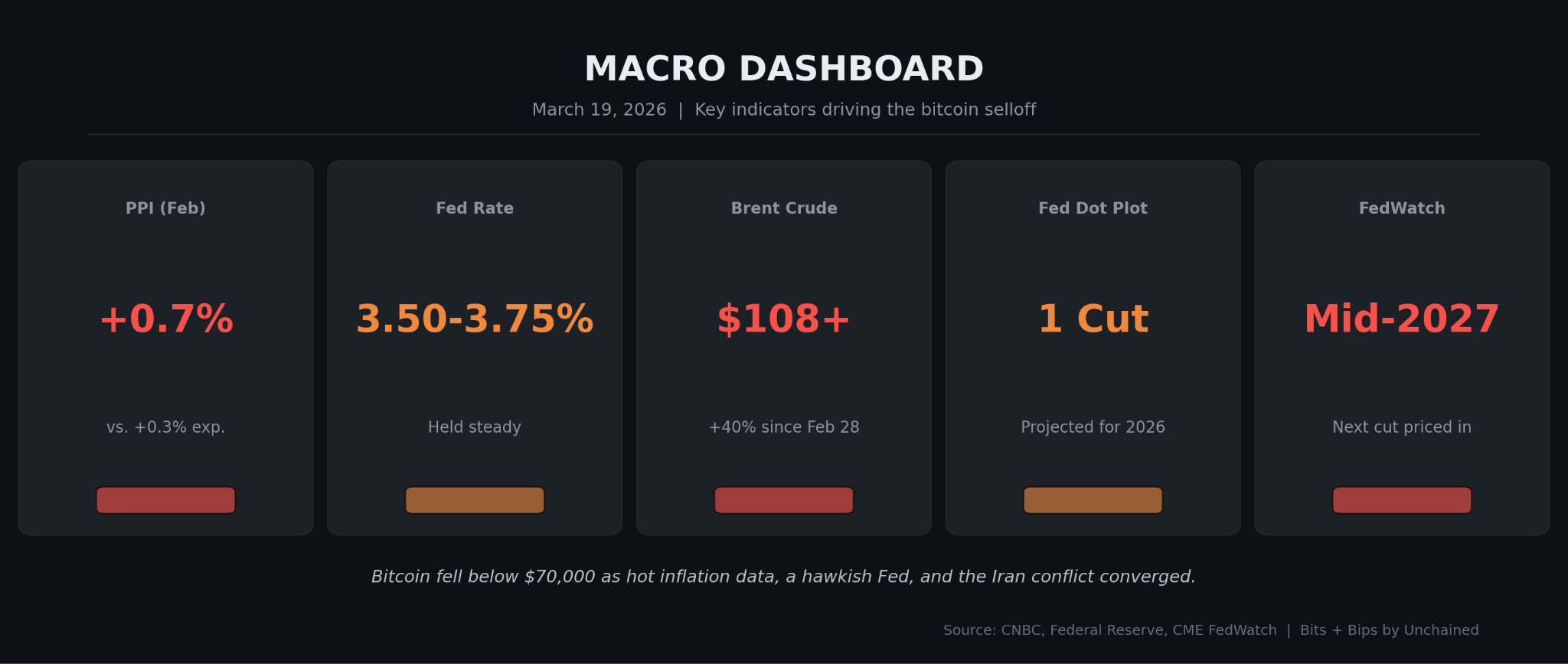
The catalyst was a pile-up of macro headwinds: the U.S. producer price index rose 0.7% in February, more than double the 0.3% economists expected. Core PPI jumped to 3.9% year-over-year, its highest in over a year. Hours later, the Federal Reserve held rates steady at 3.5% to 3.75% and projected only one cut for the remainder of 2026. Chair Powell's tone was cautiously hawkish, emphasizing that rate cuts would require real progress on inflation, particularly goods inflation driven higher by tariffs and surging energy costs.
Energy costs are the other half of this story. The Israel-Iran conflict has pushed Brent crude above $108 per barrel, up roughly 40% since the war began in late February. Israeli strikes on Iran's South Pars gas field, the world's largest, triggered a new round of retaliation threats and pushed oil prices toward levels not seen since 2022. Rising energy prices feed directly into producer costs, which drive consumer inflation, which makes the Fed reluctant to cut. The loop is tightening.
The Company That Bought the Dip (And Then the Dip Got Deeper)
Here's the part most people are not connecting. Strategy, the largest corporate holder of bitcoin, owns 761,068 BTC purchased at an average price of $75,696. At Thursday's price of roughly $69,100, the company is sitting on approximately $5 billion in unrealized losses across its entire stack. That is not a crisis. Strategy has no debt covenants that would force a liquidation, and its $2.25 billion in cash reserves can cover about 25 months of dividend obligations.
But Strategy's buying engine has quietly shifted. Last week, the company bought 22,337 BTC for $1.57 billion, its fifth-largest acquisition ever. Of that, roughly $1.18 billion, or 75%, came from selling shares of STRC, Strategy's perpetual preferred stock. Benchmark analysts have called STRC the "primary engine" for the company's bitcoin accumulation going forward.
STRC is a preferred share designed to trade near $100 par value while paying an 11.5% annualized variable dividend. In calm markets, the instrument works beautifully: investors buy STRC for yield, Strategy sells STRC into the market, and the proceeds go straight into bitcoin.
The question investors should be asking is simple: what happens to that machine in a bear market like this one?
Strategy has built a $10 billion preferred securities stack around an asset it has vowed never to sell, and the interest clock is running at over $1 billion per year with zero operating income to cover it. The macro environment that's crushing bitcoin is the same one that threatens the machine buying it.
In this issue, we’ll go over:
The STRC feedback loop in reverse: how the instrument that funded 75% of Strategy's latest bitcoin purchase depends on two sentiment-driven conditions that are both deteriorating right now, and what happens when the flywheel runs backward
The stakeholder conflict most people are ignoring: Arca CIO Jeff Dorman's argument that Strategy's four stakeholder groups, bitcoin holders, debt holders, preferred holders, and common shareholders, all believe they are safe, but mathematically cannot all be right
Three scenarios for where bitcoin goes from here: the bull, base, and bear cases, each tied to specific macro triggers and Strategy's ability to keep buying
What to watch: the concrete data points (mNAV, STRC par price, oil, and the Fed's dot plot) that will tell you whether the flywheel is holding or breaking

Reply